FAQs
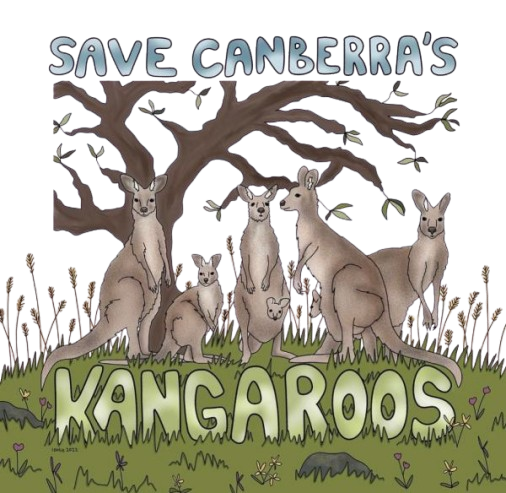
Save Canberra’s Kangaroos is a community group that advocates for the lives of Canberra’s kangaroos. We engage in online and media advocacy, protests, reserve watching, and education of the public about issues relating to kangaroos, but particularly in relation to the ACT Government’s annual kangaroo killing program.
Around March each year, the ACT Government undertakes its annual population estimates of kangaroos, as well as conducting measurements of the grass heights in Canberra’s nature reserves. Then, announced around May/June each year, the ACT Government outlines how many kangaroos and which reserves are in the firing line for their annual killing program. Once the killing begins, each night from 6pm the reserves are closed and the ACT Government shooters (both private contractors and ACT rangers) chase down and kill innocent kangaroos and their joeys until around the end of July. They call this “conservation management”.
In 2025, 2981 kangaroos were shot and killed and 1194 pouch young were decapitated or clubbed with mallets. Countless at-foot joeys orphaned – left alone, traumatised, and unlikely to have survived. Entire mob structures shattered.
Save Canberra’s Kangaroos view is there is no humane way to kill an animal who doesn’t want to die. So can the ACT Government’s annual kangaroo killing program be considered “humane”? Of course not. Aside from this, there are many other factors in relation to the annual “cull” that are the furthest thing from humane.
When kangaroos are shot but not “rendered immediately insensible”, the ACT Government calls it “wounding”. Kangaroos who suffer “wounding” are left with painful injuries until killed by a second shot, blunt force trauma to the head, or – most disturbingly – they are never found at all, and are left to endure prolonged pain. Reports from so-called “independent” veterinary audits of the ACT culls confirm that wounding is a recurring outcome.
Any joeys found in the pouches of their dead mothers are ripped out and either bludgeoned to death with a wooden mallet or decapitated. The fear they would be feeling in their final moments would be immeasurable.
Any at-foot joeys who escape the shooters who killed their mums become what’s known as the ghost population. The term “ghost populations” refers to the invisible number of orphaned joeys created when mothers are killed. These dependent young are not counted officially as victims of each cull, but they very much exist, and they very much suffer.
The ACT Government regularly claims that kangaroos are ‘over abundant’ across Canberra’s nature reserves, and each year they come out with their ‘population estimates’ in the reserves that are chosen for killing. In 2021, two passionate Canberrans undertook a massive eight-month citizen science project to identify their own population estimates of kangaroos in the nature reserves that make up Canberra Nature Park (excluding the two reserves closed to the public). Using the direct counting method, their findings were completely at odds with the ACT Government’s claims that kangaroos are “overabundant” in the reserves or are having a deleterious effect on the grassy layer. Only eight nature reserves (or 20% of ACT reserves) recorded kangaroo densities over ‘one kangaroo per hectare,’ and even then only marginally. By this measure, kangaroos are certainly not ‘overabundant’.
Kangaroos have lived on this land for millions of years and have been an important part of Australia’s environment. A native animal who belongs to the land cannot possibly cause damage to their own homes. If the ACT Government is serious about addressing the real causes of damage to the environment it must seriously confront the human-caused drivers of destruction to our precious environment. The primary causes are clear:
- Urban expansion and fragmentation: The building of Canberra itself, and the ongoing encroachment of development into rural areas, has destroyed and fragmented native habitat. Roads and high-speed traffic now bisects reserves, and development pushes right up to the fences of the reserves.
- Grazing legacy and mismanagement: The ecological legacy of a century of sheep and cattle grazing (trampling, rootstock grazing and ripping, damming of creeks to provide water to cattle & sheep etc) has caused irreversible damage to the CNP. Today, cattle are still allowed to graze in some reserves in a misguided attempt to manage the biomass overgrowth that was caused by the removal of too many kangaroos.
- Biomass overgrowth: With kangaroo populations now too low to manage vegetation, weeds and tall grasses have proliferated.
- Climate change: Anthropogenic climate change has caused long term changes in general weather conditions, changing the tolerability of the climate for the plants and animals that live here, and also more frequent, sustained and severe extreme weather events.
The ACT Government claims that kangaroo grazing negatively impacts threatened species such as the grassland earless dragon, the golden sunmoth, the perunga grasshopper, the scarlet robin and the list goes on. The reality is, Australia’s climate is naturally highly variable. At times, some species thrive and survive, while others decline. Sometimes there aren’t enough animals to manage vegetation, or enough vegetation to feed animals. These fluctuations are normal. Rather than indicating overgrazing – as the ACT Government suggests – they reflect a dynamic system where species adapt to changing conditions. As proven over millions of years, this variability benefits all species in the long run. There is also a long list of human caused problems that directly harm our endangered species, as well as kangaroos, such as land clearing, urban development, animal agriculture, invasive weeds, vehicle strike and of course human induced rapid climate change.
Kangaroos are not the only animal in the firing line each winter when the ACT Government undertakes its annual killing across Canberra’s nature reserves. Revealed under FOI in 2024, more than two thirds of the resident wallaby population inside Mulligans Flat Woodland “Sanctuary” were shot and killed. When it was revealed that this was occurring, Save Canberra’s Kangaroos was advised that this was part of ‘normal routine management of the site’ indicating that this could have been going on for years in secret.
Additionally, the ACT Government uses the bodies of the killed kangaroos and turns them into 1080 baits to kill dingoes in Namadgi National Park. This risks driving dingo populations to dangerously low levels. A leading ACT dingo researcher has already warned that dingoes could be on a “trajectory towards extinction”. If dingoes disappear, will the ACT Government then claim that kangaroos in Namadgi must be killed too?
Yes, sadly kangaroos are killed right across Australia by government killing programs, rural leaseholders and the commercial industry. There are many groups around the country advocating for an end to this senseless and cruel killing, and we recommend you check them out:
If you’re an ACT resident, please write to your local MLAs demanding an end to the killing of kangaroos in the ACT, as well as pleading for wildlife collision mitigation measures and for the ACT Government to allow ACT wildlife carers to be able to rescue, rehabilitate and euthanise injured kangaroos and their joeys.
Not an ACT resident? That’s okay, we suggest writing directly to the ACT Minister for Environment, Suzanne Orr.
Please also follow us on socials to keep up to date!